
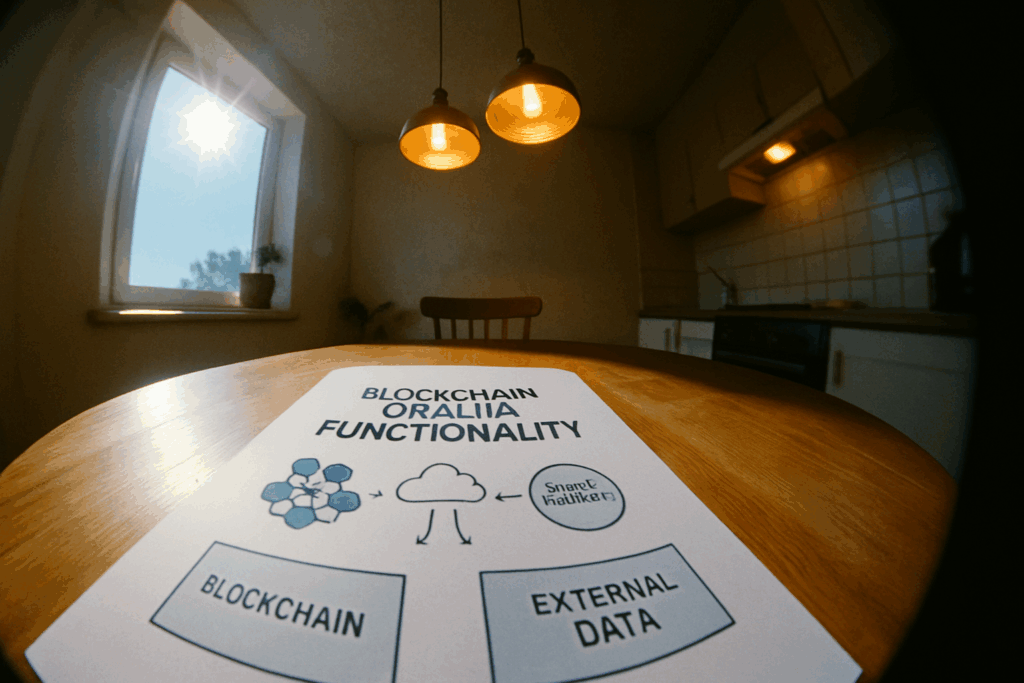
What Smart Contracts Can’t Do Alone
Smart contracts are built to do one thing well execute logic based on the data they already know. They’re fast, reliable, and free from human bias. But here’s the catch: all that power stays locked inside the blockchain. These contracts can’t reach outside their own environment, which means they can’t directly access real world data.
This limitation matters. A lot. Think about a decentralized insurance policy that needs to know if it rained on a specific day, a lending protocol that adjusts loans based on real time market prices, or a sports betting app that has to settle based on a game’s final score. None of these use cases work without external data.
So despite all the hype, smart contracts aren’t really all that smart on their own. They need help bringing outside information into their world and that’s where oracles come in. Without that bridge, many practical blockchain applications simply don’t run.
Enter the Oracle: The Missing Link
Smart contracts are built to execute automatically, but there’s a catch they can only work with data available inside the blockchain. That’s where oracles come in. In simple terms, an oracle is a bridge that connects smart contracts to the outside world. They feed real world data like stock prices, weather conditions, or football scores into the blockchain so smart contracts can react based on that information.
Not all oracles function the same way. You’ve got software oracles, which pull data from APIs across the web. Then there are hardware oracles that rely on physical sensors or IoT devices to deliver high stakes info think shipping scanners and climate monitors. Inbound oracles send off chain data into the blockchain, while outbound oracles do the opposite: they let a smart contract trigger actions outside the chain, like opening a smart lock or sending a confirmation SMS.
There’s also the question of who you trust to deliver this data. Centralized oracles rely on a single source or provider. Simple, sure but vulnerable if that single point fails or is compromised. Decentralized oracles, on the other hand, draw from multiple data sources and providers, spreading the risk and increasing reliability. It’s a slower setup but more secure something DeFi apps and enterprise users are betting big on.
Want to go deeper? Check out this breakdown on the role of oracles.
Real World Use Cases

Oracles aren’t abstract tech they’re solving problems here and now. In sectors where time and accuracy are make or break, oracles are stepping in as the connective tissue between blockchain logic and physical reality.
Take insurance. Parametric insurance products rely on specific, measurable events like rainfall levels or wind speeds. Oracles feed trusted weather data from sources like the National Weather Service directly into smart contracts, which can then trigger payouts automatically. No adjusters, no waiting, no paperwork.
In DeFi, oracles are lifelines for accurate pricing. Lending platforms need up to the second price feeds for crypto assets to know when to trigger liquidations or adjust collateral requirements. Without reliable oracles (like Chainlink or Pyth), the system breaks.
Supply chains are also getting an upgrade. By connecting IoT devices GPS trackers, temperature monitors, RFID scanners to blockchain through oracles, companies can verify conditions and location of goods in real time. It’s not just about knowing where a product is, but verifying it hasn’t spoiled, been tampered with, or delayed.
Then there’s prediction markets and betting. These platforms depend on verified reality who won the election, what team scored, what verdict came in. Oracles close that loop, pulling results from trusted APIs and pushing outcomes on chain to resolve bets or distribute rewards.
Oracles aren’t just messengers. They’re the reason smart contracts can interact with a messy, unpredictable world and still execute cleanly.
Risks and Challenges
While blockchain smart contracts are known for their security and transparency, the oracles that feed them data come with their own set of vulnerabilities. Ensuring trust and reliability in these data sources is critical to making smart contracts work as intended.
The Oracle Manipulation Threat
A major risk with oracle systems is manipulation. Because smart contracts depend on external data to function properly, a compromised oracle can feed false information triggering incorrect outcomes or financial exploits.
Attackers can spoof or alter incoming data
Smart contract logic may execute based on faulty inputs
Single point of failure in centralized oracle setups
The Fragility of Data Sources
Not all data is created equal. Some oracles pull from web APIs, news feeds, or sensors each with varying degrees of accuracy and security.
External APIs can change or go offline without warning
Hardware inputs (like IoT sensors) may be vulnerable to tampering
Lack of clear audit trails for some data sources
The Role of Decentralized Oracles
Decentralized oracle networks help mitigate risks by spreading trust across independent data providers. They improve reliability through aggregation and cryptographic verification.
Multiple data providers reduce reliance on a single source
Consensus among nodes helps detect and discard outliers
Popular decentralized oracle projects include Chainlink and Band Protocol
Understanding the “Oracle Problem”
This collective set of vulnerabilities and dependencies is often referred to as the “oracle problem.” It highlights the difficulty of securely linking off chain data to on chain logic.
Solutions in development include:
Cryptographic proofs for data integrity
AI driven validation layers to detect anomalies
On chain governance mechanisms for data dispute resolution
Bridging Trust Back to Oracles
For a deeper explanation of how the blockchain community is addressing these challenges, revisit the complete role of oracles in reinforcing data security and trust.
Oracles are evolving rapidly, but their risks and the solutions to them are just as crucial to the future of Web3 as smart contracts themselves.
What’s Next for Oracles in Web3
Oracles are moving past the experimentation phase. Real world adoption is ramping up across finance, insurance, gaming, and supply chain tech. Enterprises and decentralized apps are starting to treat oracles not as a bolt on, but as core infrastructure. If data drives decisions and it does then high integrity sources become mission critical.
One major shift underway: the blend of oracles with AI. Machine learning models are now being layered onto oracle nodes to help validate input data before it hits the blockchain. The goal is better filtering, less noise, and tighter security. It also means oracles can start understanding data, not just delivering it.
Perhaps most telling: some developers are treating oracle networks like a base layer, right alongside consensus mechanisms and smart contract engines. These networks aren’t just data relays anymore they’re becoming decentralized backbones for intelligence, automation, and trust in Web3 systems. Whether blockchain reaches mainstream adoption will depend, in part, on how strong and scalable these oracle layers become.
TL;DR Value
At their core, oracles make smart contracts actually useful. Without them, smart contracts are stuck in a bubble they can’t tell you what the real world temperature is, whether a soccer game ended in a draw, or what the current ETH price is. Oracles bridge that data gap, making sure contracts can execute based on real world events, not just on chain logic.
This matters most in places like DeFi, where accuracy can make or break a lending protocol, or insurance platforms, where a payout depends on the weather turning bad. Trust, automation, and correctness all hang on whether the oracle feeding the contract is doing its job.
And as blockchain tech goes mainstream, oracle design becomes non negotiable. We’re talking more demand, more complexity meaning the oracle networks of tomorrow need to be faster, more secure, and more versatile than ever before. Smart contracts only become as smart as the data they can trust. With oracles, that’s finally possible.
 Tavien Zelthorne writes the kind of blockchain technology discussions content that people actually send to each other. Not because it's flashy or controversial, but because it's the sort of thing where you read it and immediately think of three people who need to see it. Tavien has a talent for identifying the questions that a lot of people have but haven't quite figured out how to articulate yet — and then answering them properly.
They covers a lot of ground: Blockchain Technology Discussions, Investment Strategies for Cryptocurrencies, Crypto News and Updates, and plenty of adjacent territory that doesn't always get treated with the same seriousness. The consistency across all of it is a certain kind of respect for the reader. Tavien doesn't assume people are stupid, and they doesn't assume they know everything either. They writes for someone who is genuinely trying to figure something out — because that's usually who's actually reading. That assumption shapes everything from how they structures an explanation to how much background they includes before getting to the point.
Beyond the practical stuff, there's something in Tavien's writing that reflects a real investment in the subject — not performed enthusiasm, but the kind of sustained interest that produces insight over time. They has been paying attention to blockchain technology discussions long enough that they notices things a more casual observer would miss. That depth shows up in the work in ways that are hard to fake.
Tavien Zelthorne writes the kind of blockchain technology discussions content that people actually send to each other. Not because it's flashy or controversial, but because it's the sort of thing where you read it and immediately think of three people who need to see it. Tavien has a talent for identifying the questions that a lot of people have but haven't quite figured out how to articulate yet — and then answering them properly.
They covers a lot of ground: Blockchain Technology Discussions, Investment Strategies for Cryptocurrencies, Crypto News and Updates, and plenty of adjacent territory that doesn't always get treated with the same seriousness. The consistency across all of it is a certain kind of respect for the reader. Tavien doesn't assume people are stupid, and they doesn't assume they know everything either. They writes for someone who is genuinely trying to figure something out — because that's usually who's actually reading. That assumption shapes everything from how they structures an explanation to how much background they includes before getting to the point.
Beyond the practical stuff, there's something in Tavien's writing that reflects a real investment in the subject — not performed enthusiasm, but the kind of sustained interest that produces insight over time. They has been paying attention to blockchain technology discussions long enough that they notices things a more casual observer would miss. That depth shows up in the work in ways that are hard to fake.